Kernel density based local two-sample comparison test
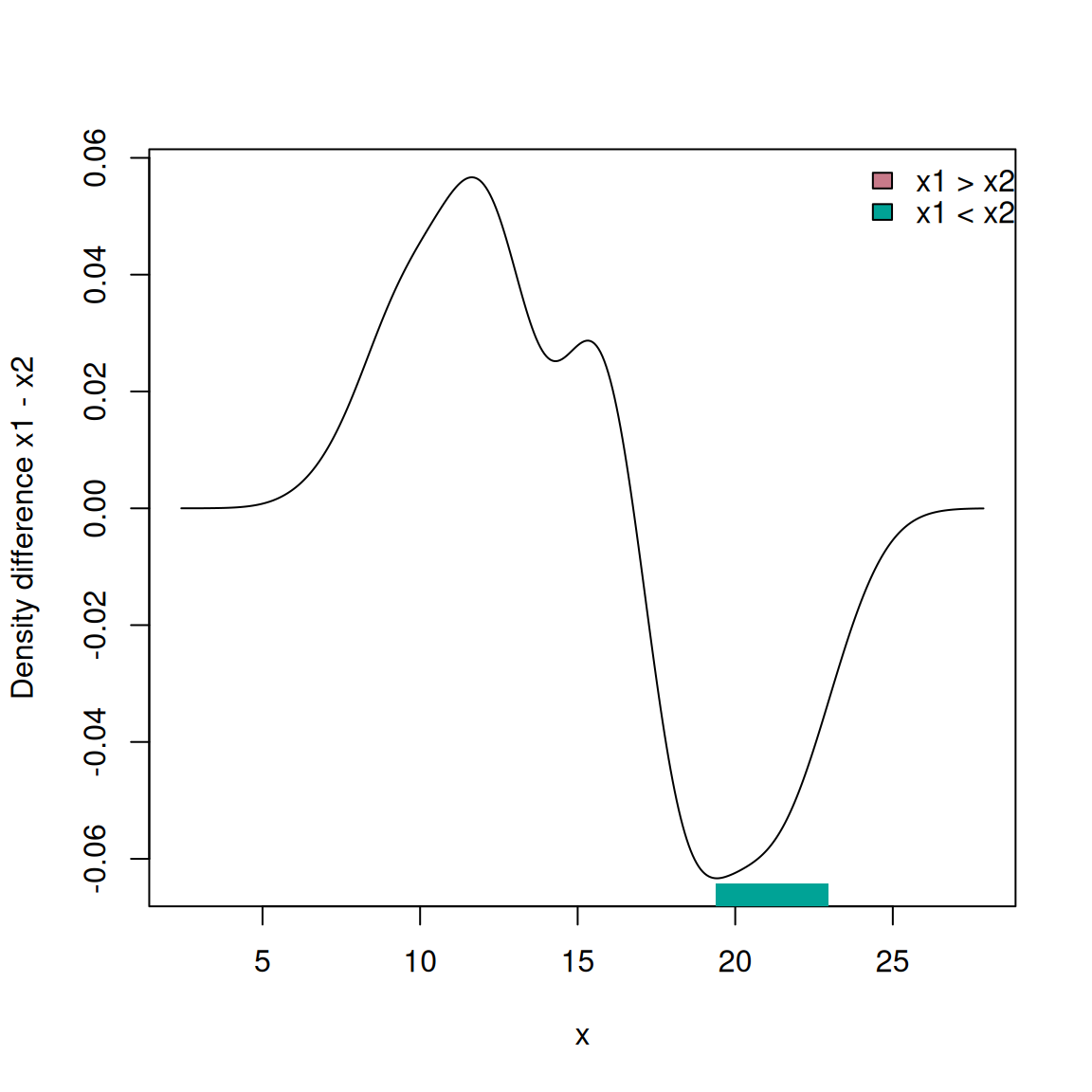
kde.local.test.RdKernel density based local two-sample comparison test for 1- to 6-dimensional data.
Usage
kde.local.test(x1, x2, H1, H2, h1, h2, fhat1, fhat2, gridsize, binned,
   bgridsize, verbose=FALSE, supp=3.7, mean.adj=FALSE, signif.level=0.05,
   min.ESS, xmin, xmax)
Arguments
- x1,x2
vector/matrix of data values
- H1,H2,h1,h2
bandwidth matrices/scalar bandwidths. If these are missing,
Hpiorhpiis called by default.- fhat1,fhat2
objects of class
kde- binned
flag for binned estimation
- gridsize
vector of grid sizes
- bgridsize
vector of binning grid sizes
- verbose
flag to print out progress information. Default is FALSE.
- supp
effective support for normal kernel
- mean.adj
flag to compute second order correction for mean value of critical sampling distribution. Default is FALSE. Currently implemented for d<=2 only.
- signif.level
significance level. Default is 0.05.
- min.ESS
minimum effective sample size. See below for details.
- xmin,xmax
vector of minimum/maximum values for grid
Value
A kernel two-sample local significance is an object of class
kde.loctest which is a list with fields:
- fhat1,fhat2
kernel density estimates, objects of class
kde- chisq
chi squared test statistic
- pvalue
matrix of local \(p\)-values at each grid point
- fhat.diff
difference of KDEs
- mean.fhat.diff
mean of the test statistic
- var.fhat.diff
variance of the test statistic
- fhat.diff.pos
binary matrix to indicate locally significant fhat1 > fhat2
- fhat.diff.neg
binary matrix to indicate locally significant fhat1 < fhat2
- n1,n2
sample sizes
- H1,H2,h1,h2
bandwidth matrices/scalar bandwidths
Details
The null hypothesis is \(H_0(\bold{x}): f_1(\bold{x}) = f_2(\bold{x})\) where \(f_1, f_2\) are the respective density functions. The measure of discrepancy is \(U(\bold{x}) = [f_1(\bold{x}) - f_2(\bold{x})]^2\). Duong (2013) shows that the test statistic obtained, by substituting the KDEs for the true densities, has a null distribution which is asymptotically chi-squared with 1 d.f.
The required input is either x1,x2 and H1,H2, or
fhat1,fhat2, i.e. the data values and bandwidths or objects of class
kde. In the former case, the kde objects are created.
If the H1,H2 are missing then the default are the plug-in
selectors Hpi. Likewise for missing h1,h2.
The mean.adj flag determines whether the
second order correction to the mean value of the test statistic should be computed.
min.ESS is borrowed from Godtliebsen et al. (2002)
to reduce spurious significant results in the tails, though by it is usually
not required for small to moderate sample sizes.
References
Duong, T. (2013) Local significant differences from non-parametric two-sample tests. Journal of Nonparametric Statistics 25, 635–645.
Godtliebsen, F., Marron, J.S. & Chaudhuri, P. (2002) Significance in scale space for bivariate density estimation. Journal of Computational and Graphical Statistics 11, 1–22.