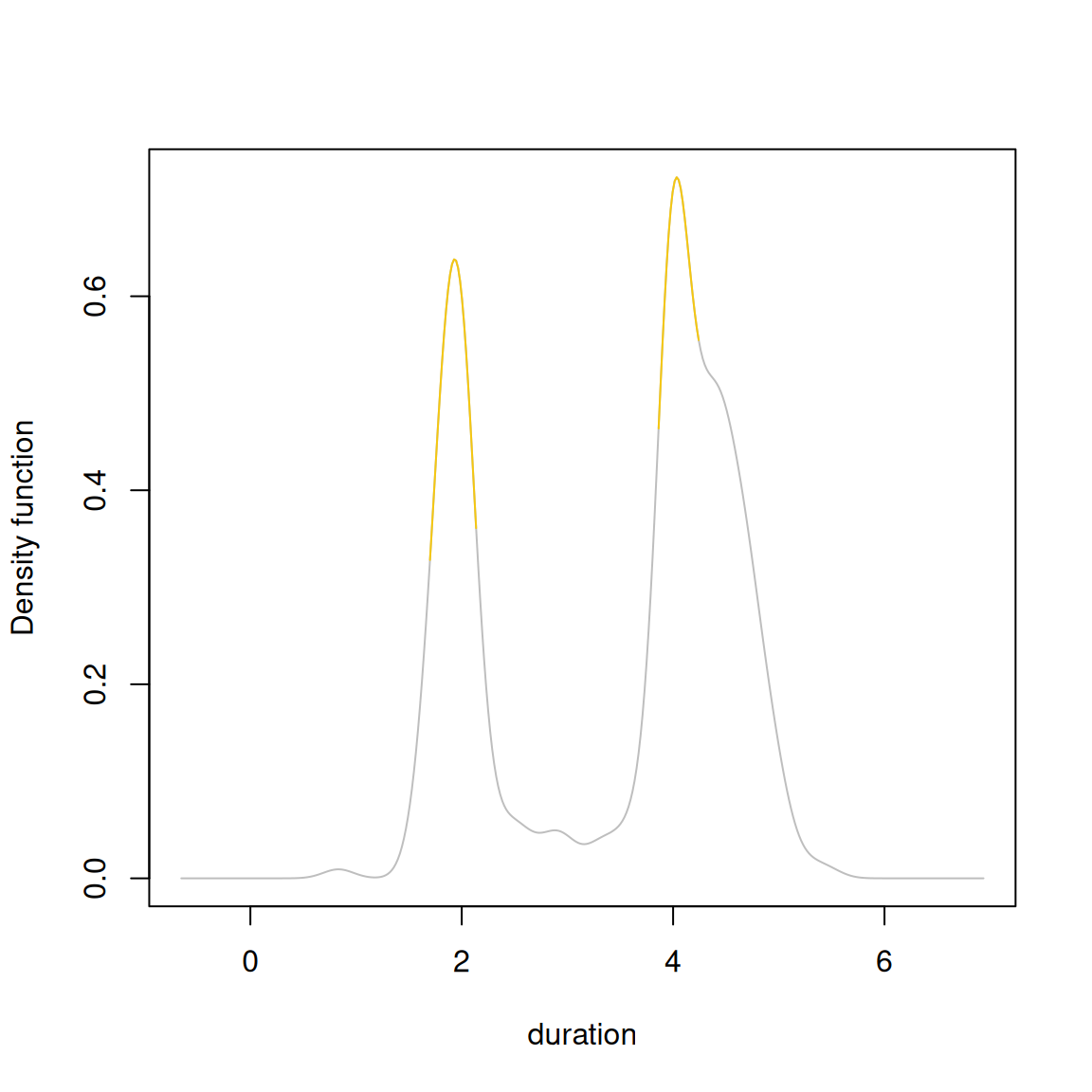
Kernel feature significance
kfs.RdKernel feature significance for 1- to 6-dimensional data.
Usage
kfs(x, H, h, deriv.order=2, gridsize, gridtype, xmin, xmax, supp=3.7,
    eval.points, binned, bgridsize, positive=FALSE, adj.positive, w,
    verbose=FALSE, signif.level=0.05)
Arguments
- x
matrix of data values
- H,h
bandwidth matrix/scalar bandwidth. If these are missing,
Hpiorhpiis called by default.- deriv.order
derivative order (scalar)
- gridsize
vector of number of grid points
- gridtype
not yet implemented
- xmin,xmax
vector of minimum/maximum values for grid
- supp
effective support for standard normal
- eval.points
vector or matrix of points at which estimate is evaluated
- binned
flag for binned estimation
- bgridsize
vector of binning grid sizes
- positive
flag if 1-d data are positive. Default is FALSE.
- adj.positive
adjustment applied to positive 1-d data
- w
vector of weights. Default is a vector of all ones.
- verbose
flag to print out progress information. Default is FALSE.
- signif.level
overall level of significance for hypothesis tests. Default is 0.05.
Value
A kernel feature significance estimate is an object of class
kfs which is a list with fields
- x
data points - same as input
- eval.points
vector or list of points at which the estimate is evaluated
- estimate
binary matrix for significant feature at
eval.points: 0 = not signif., 1 = signif.- h
scalar bandwidth (1-d only)
- H
bandwidth matrix
- gridtype
"linear"
- gridded
flag for estimation on a grid
- binned
flag for binned estimation
- names
variable names
- w
vector of weights
- deriv.order
derivative order (scalar)
- deriv.ind
martix where each row is a vector of partial derivative indices.
This is the same structure as a kdde object, except that
estimate is a binary matrix rather than real-valued.
Details
Feature significance is based on significance testing of the gradient (first derivative) and curvature (second derivative) of a kernel density estimate. Only the latter is currently implemented, and is also known as significant modal regions.
The hypothesis test at a grid point \(\bold{x}\) is
\(H_0(\bold{x}): \mathsf{H} f(\bold{x}) < 0\),
i.e. the density Hessian matrix \(\mathsf{H} f(\bold{x})\) is negative definite.
The \(p\)-values are computed for each \(\bold{x}\) using that
the test statistic is
approximately chi-squared distributed with \(d(d+1)/2\) d.f.
We then use a Hochberg-type simultaneous testing procedure, based on the
ordered \(p\)-values, to control the
overall level of significance to be signif.level. If
\(H_0(\bold{x})\) is rejected then \(\bold{x}\)
belongs to a significant modal region.
The computations are based on kdde(x, deriv.order=2) so
kfs inherits its behaviour from kdde.
If the bandwidth H is missing, then
the default bandwidth is the plug-in selector
Hpi(deriv.order=2). Likewise for missing h.
The effective support, binning, grid size, grid range, positive
parameters are the same as kde.
This function is similar to the featureSignif function in the
feature package, except that it accepts unconstrained bandwidth
matrices.
References
Chaudhuri, P. & Marron, J.S. (1999) SiZer for exploration of structures in curves. Journal of the American Statistical Association 94, 807–823.
Duong, T., Cowling, A., Koch, I. & Wand, M.P. (2008) Feature significance for multivariate kernel density estimation. Computational Statistics and Data Analysis 52, 4225–4242.
Godtliebsen, F., Marron, J.S. & Chaudhuri, P. (2002) Significance in scale space for bivariate density estimation. Journal of Computational and Graphical Statistics 11, 1–22.